 BorderLedger
What the SRT decides
The Statutory Residence Test is used to determine whether an individual is UK tax resident for a particular UK tax year. A tax year runs from 6 April to 5 April the following year. Your status can change from one tax year to the next, and special rules such as split-year treatment may also matter.
The answer is not based on a single day limit. The test considers UK days, work patterns, homes and other UK connections. HMRC’s guidance applies the tests in sequence, and some results end the process before later tests are considered.
Important: fewer than 183 UK days does not automatically mean non-resident. An automatic overseas test or the sufficient ties test can determine the result at a lower day count.
The decision path—and each possible output
HMRC describes an initial 183-day check followed by the automatic overseas tests, the remaining automatic UK tests and then the sufficient ties test. BorderLedger presents the last three as its three in-app stages.
Were you in the UK for 183 days or more?
Count UK days in the tax year under review.
Does any automatic overseas test apply?
Low UK-day thresholds or qualifying full-time work overseas may meet a test.
Does a qualifying UK home or UK work test apply?
These include the UK-home test and the full-time UK-work test; the 183-day test was checked first.
Do your UK days and ties meet the threshold?
The required number of ties depends on UK-day count and whether you were UK resident in any of the previous three tax years.
App stage 1: automatic overseas tests
If an automatic overseas test applies, the person is non-UK resident for that tax year. For living individuals, the tests include low UK-day limits based on recent residence history and a full-time work overseas test.
- Previously UK resident: one automatic overseas test can apply when you were UK resident in one or more of the previous three tax years and spend fewer than 16 days in the UK in the year being tested.
- Not recently UK resident: another test can apply when you were not UK resident in any of the previous three tax years and spend fewer than 46 UK days.
- Full-time work overseas: this test has several conditions, including fewer than 91 UK days, fewer than 31 UK workdays on which you work more than three hours, sufficient overseas work, and no significant break from overseas work.
These are tests with detailed statutory definitions. “Full-time overseas work” is not simply a job title or a yes/no description; work hours, workdays, breaks, travel and the tax-year period all matter.
App stage 2: automatic UK tests
If no automatic overseas test settles the question, one of the automatic UK tests may make you UK resident. The first is the 183-day test. Other tests look at a qualifying UK home or full-time work in the UK.
- UK-home test: the rules examine factors including a qualifying period of at least 91 consecutive days, how many of those days fall in the tax year, presence in the home, and whether an overseas home is available and used.
- Full-time UK-work test: the rules examine a 365-day period, the proportion of workdays in the UK and whether the required UK workday falls in the relevant tax year.
The short descriptions above are signposts, not the full tests. A home, a workday and “full-time” each have definitions and conditions in HMRC guidance.
App stage 3: the sufficient ties test
This stage is considered when neither an automatic overseas nor an automatic UK test has already determined the result. It combines UK days with relevant UK ties. The more days you spend in the UK, the fewer ties may be needed.
Possible ties include family, accommodation, work and spending 90 days or more in the UK in either of the previous two tax years. If you were UK resident in one or more of the previous three tax years, a country tie can also be relevant. Each tie has detailed eligibility rules.
| UK days in year | Resident in 1+ of previous 3 years | Not resident in previous 3 years |
|---|---|---|
| 16–45 | 4 ties | Not applicable to this table |
| 46–90 | 3 ties | 4 ties |
| 91–120 | 2 ties | 3 ties |
| More than 120 | 1 tie | 2 ties |
The table is a high-level summary of HMRC’s sufficient-ties thresholds for living individuals. It does not cover every edge case, including deceased persons or split-year treatment.
How BorderLedger presents the SRT guide
The app opens the UK SRT guide from the UK-presence indicator on the Stats screen. It shows UK days for the selected tax year and asks about relevant circumstances in sequence. A definitive outcome at an earlier stage means later stages are not needed in that flow.
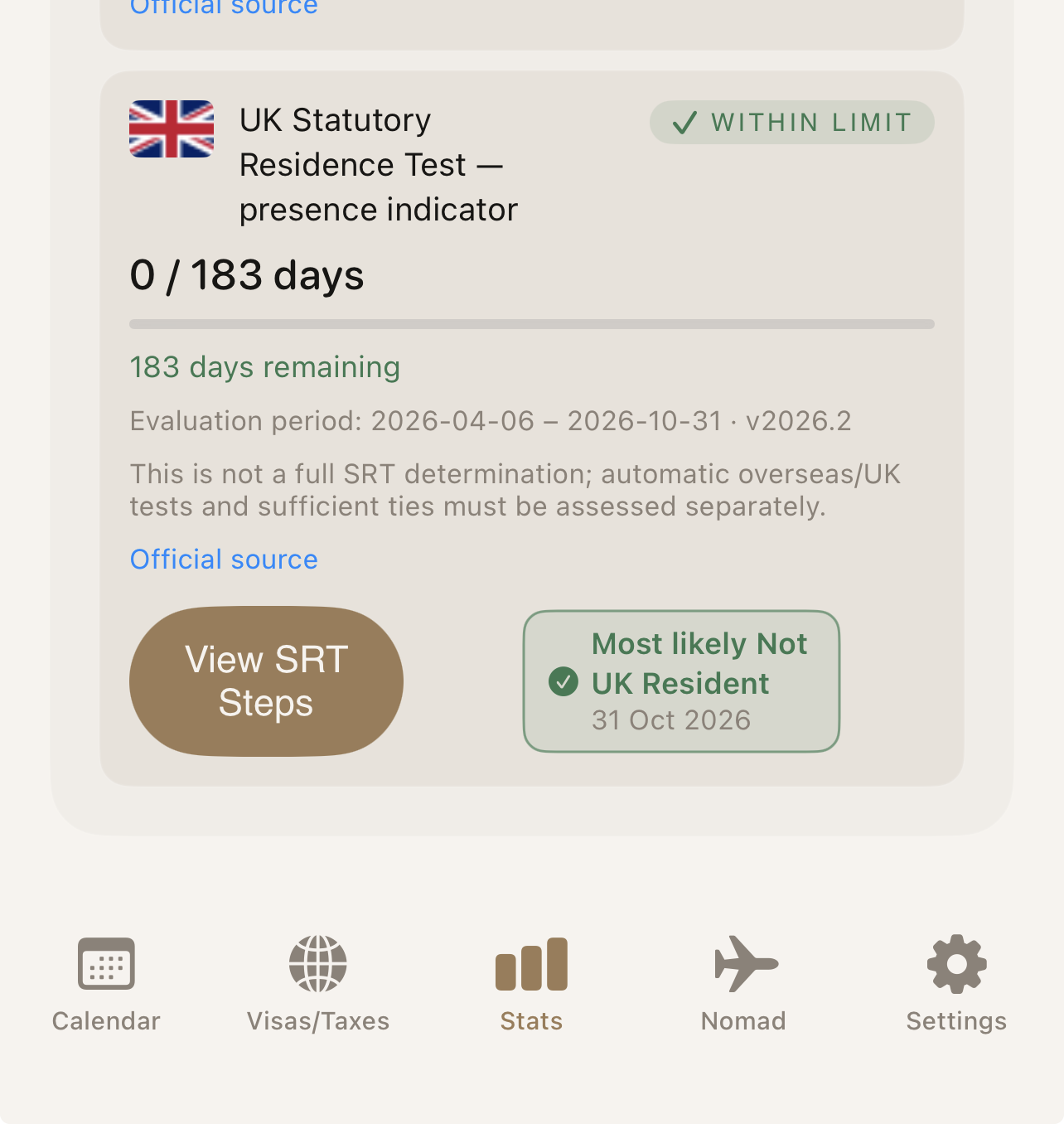
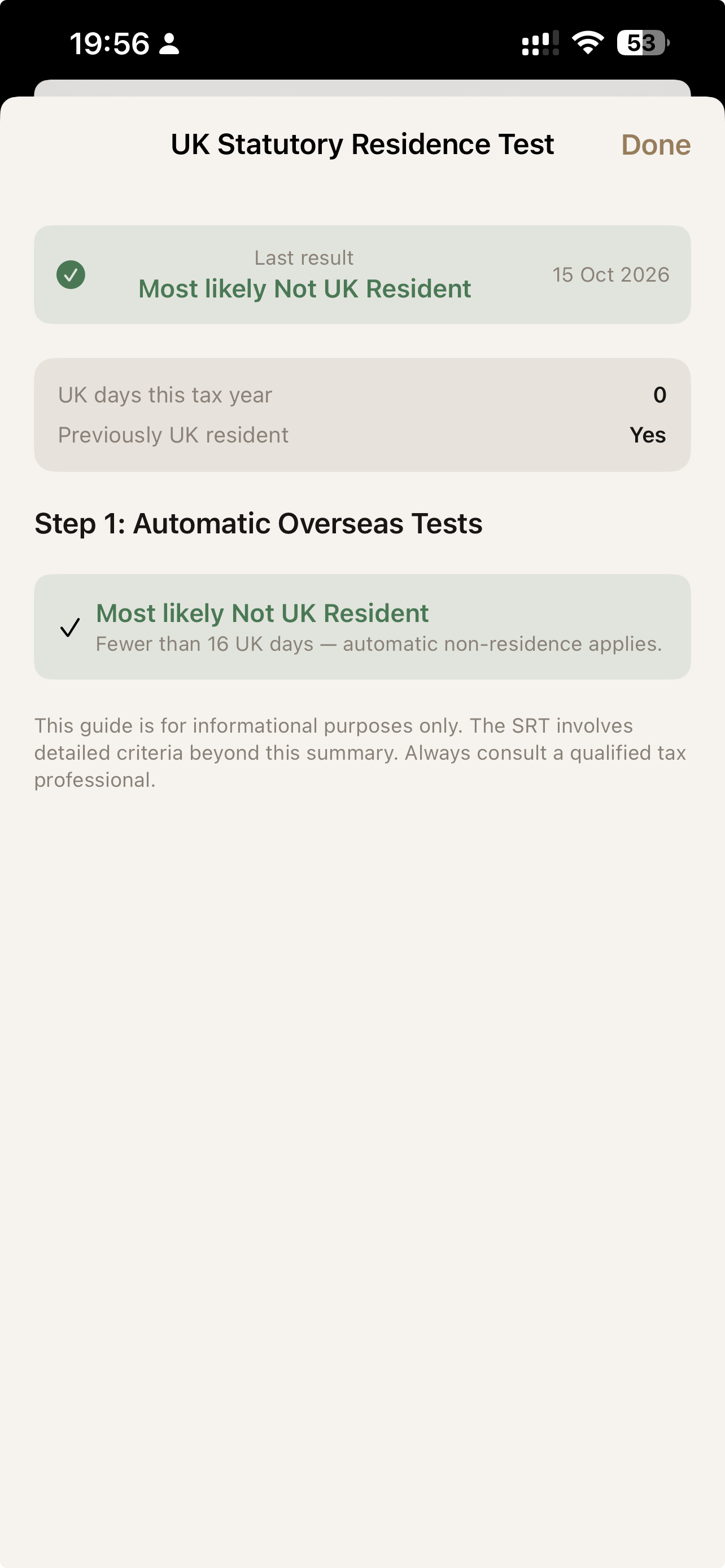
In the supplied screenshots, the card shows 0 of 183 UK days for the tax year-to-date on 31 October 2026. The detailed guide also shows that the account was previously UK resident and a saved “Most likely Not UK Resident” result from 15 October. The two dates describe separate screen states; the saved result is not a new determination made on the card’s display date.
What an in-app result can—and cannot—tell you
The BorderLedger guide is a structured planning aid. Its screens summarize key SRT questions and use logged UK-day history to support some tie prompts. The app itself describes the outcome as “most likely” and warns that a full SRT determination requires a separate assessment of automatic tests and sufficient ties.
An incomplete tax year needs particular care. A year-to-date count is not a forecast of future UK days, work or home circumstances. A result also depends on accurate travel history and answers, and may need to account for split-year treatment or other special rules. Review the official guidance and seek qualified tax advice for decisions about your residence or tax return.
Official sources
- HMRC: RDR3 Statutory Residence Test guidance — the overview, automatic tests, sufficient ties and split years.
- GOV.UK: UK residence and tax — the tax-year definition and a short overview of residence tests.
- HMRC Residence and FIG Manual RFIG20040 — the order used to apply the SRT.
- HMRC Residence and FIG Manual RFIG20520 — sufficient-ties thresholds.
This article is general information, not tax or legal advice. The official rules and your circumstances determine your status; an app cannot make a binding HMRC determination.